Every superintendent has a story- a ladder tied off wrong. A trench that looked fine until it didn’t. A subcontractor who assumed someone else was watching the crane’s swing radius. None of these things happen because people don’t care about safety. They happen because on a busy jobsite, with five trades working at once and the schedule always breathing down someone’s neck, small gaps hide in plain sight — until they don’t.
A construction safety audit is how contractors get ahead of that. It’s a structured way to dig into hazards, check compliance, put deficiencies in writing, and map out fixes before something goes wrong. Do it consistently, and you’re not just avoiding fines; you’re building a jobsite culture where safety is just how things get done.
What Is a Construction Safety Audit?
A construction safety audit is basically a systematic evaluation of workplace conditions, safety procedures, documentation stuff, employee practices, equipment, and regulatory compliance stuff. It is not like a quick eyeballing either. An audit looks at whether the safety controls that are already supposed to be in place are actually used and effective.
During the audit, safety professionals might review fall protection, scaffolding, excavation areas, electrical systems, PPE, machinery, emergency procedures, training records, permits, and incident documentation. The goal is not only to spot hazards, but to figure out why those weak points show up, and what corrective measures should be put into place next.
How a Safety Audit Differs from a Daily Inspection or Toolbox Talk
A daily inspection is narrower by design. A daily inspection is fast and situational; a supervisor checking access routes, housekeeping, and barricades before the crew starts moving. A toolbox talk is even narrower, a five-minute conversation about the hazards tied to that day’s specific task.
An audit is neither of those. It steps back and looks at the whole picture: conditions, policies, records, training, and whether anyone’s actually accountable when something falls through the cracks. That’s what makes a jobsite safety audit valuable in a way daily checks simply aren’t built to be: it catches the slow, systemic stuff that never shows up in a five-minute walk.
Why Construction Companies Need Regular Safety Audits
Here’s a fact that trips up a lot of safety programs: the hazards on a jobsite today aren’t the hazards you’ll have in six weeks. Excavation gives way to framing, framing gives way to mechanical rough-in, and by the time you’re commissioning the building, half your original controls don’t even apply anymore. A safety plan written once at kickoff and never revisited is already out of date by the second phase. Regular audits are how you keep pace with a site that refuses to sit still.
OSHA’s ‘Fatal Four’ and Injury Prevention
Falls. Struck-by. Electrocution. Caught-in or caught-between. If you’ve spent any time in construction safety, you already know these as OSHA’s “Fatal Four,” and for good reason. Together they account for the vast majority of construction deaths every single year, and none of them stay confined to one trade or one phase of work.
Auditing is how you confirm the basics are actually holding: fall protection installed correctly, electrical systems maintained the way they’re supposed to be, equipment operators following real procedures instead of shortcuts, workers kept clear of moving machinery. One missed detail in any of these areas can be the entire difference between a close call and a fatality. That’s not an exaggeration; it’s just the math of this industry.
Avoiding Costly Delays, Fines, and Legal Exposure
Safety failures rarely stay contained. They stall production, invite investigations, blow up schedules, and open the door to serious financial exposure. OSHA fines get the headlines, but they’re often the smaller line item; medical bills, workers’ comp claims, damaged equipment, litigation, and rework can add up to far more.
Catch a deficiency while it’s still small, and it costs you a work order and maybe an uncomfortable conversation. Catch it after someone gets hurt, and it costs you a lot more than money. Beyond the immediate savings, documented corrective actions give you something to point to later; proof that your company had a real process for finding and fixing problems, not just a policy binder nobody opened.
Protecting Insurance Rates and Bonding Capacity
Somewhere behind the scenes, insurers, sureties, GCs, and owners are all forming a picture of how risky your company is to work with; and a documented safety program plays a bigger role in that picture than most contractors realize. Unresolved findings and repeat incidents are exactly the kind of thing that quietly raises premiums or costs you a bid.
Contractors who audit consistently and who can show closed-out findings rather than open ones walk into those conversations with real leverage. It’s the difference between saying “we’re safe” and being able to prove it with a paper trail.
Types of Construction Safety Audits
Not every job calls for the same audit approach. What makes sense depends on the size of the project, its complexity, what the contract requires, the risk profile, and how much safety capacity you’ve already got in-house.
Internal Audits vs. Independent Second-Party Audits
Your own people know the project cold: the policies, the workflows, the personalities. That makes internal audits efficient for routine, ongoing monitoring.
But familiarity cuts both ways. After enough time on a site, it’s human nature to stop seeing the things you walk past every day. That’s exactly the blind spot an independent second-party construction safety inspection is built to catch. An outside set of eyes will flag things your own team has quietly stopped noticing- their findings carry more credibility when an owner or insurer wants documentation that isn’t self-graded.
New Build, Renovation, and Expansion Audits
New builds bring the classic risks: excavation, structural work, temporary utilities, cranes, a site layout that’s different every month. Renovations are trickier in a different way, often unfolding right next to occupied buildings, live utilities, or operations that can’t afford to shut down.
Expansion projects sit somewhere in between- requiring real coordination between what’s already standing and what’s going up next to it. None of these situations are well served by a generic, off-the-shelf checklist. The audit has to reflect the actual site in front of you.
Milestone and Stage-Gate Audits
Some of the most useful audits happen at the hinge points of a project; right before structural work kicks off, ahead of a major equipment install, before commissioning or occupancy. A milestone audit forces a hard stop and an honest question: are we actually ready to move into the next phase, or are we about to drag an unresolved problem into something more complicated?
What a Construction Safety Audit Covers
A thorough audit doesn’t stop at what you can see from the ground floor. It looks at how people, equipment, procedures, and paperwork all interact, because most serious incidents aren’t caused by one failure. They’re caused by two or three small ones stacking up at the same time.
PPE Usage and Equipment Operation
This starts with the basics: do workers have the right gear for the task, and do they actually understand its limits? Hard hats, eye protection, gloves, hearing protection, respiratory protection, fall-arrest systems, high-visibility clothing; all of it gets checked against the real hazards present on that site, not a generic list.
Equipment gets the same treatment. Machine guarding, inspection logs, operator qualifications, maintenance records, lockout/tagout practices; and whether the crew running cranes, lifts, and forklifts is actually following the procedures they trained on, not the shortcuts that crept in over time.
Subcontractor Safety Coordination
Put several trades in a confined space at the same time and overlapping hazards show up whether anyone planned for them or not. Good coordination lives in the details: who has access and when, how energy sources get locked out, who owns a given fall hazard, how material handling and emergency plans get communicated across crews that don’t usually talk to each other.
Part of the audit is simply confirming subcontractors actually understand the site-specific rules, and that the GC is providing real oversight, not just assuming the safety plan got read. Clear ownership is what prevents the situation where two trades each assume the other is watching a shared hazard, and it turns out nobody is.
Permits, Training Records, and Incident Documentation
Paperwork only means something if it lines up with what’s actually happening. Auditors dig through permits, training certifications, inspection logs, incident reports, near-miss records, disciplinary history, and corrective-action logs, looking for the gap between what’s written down and what’s true in the field.
A solid OSHA construction compliance audit exists to close that gap. If the training records say everyone’s certified, but the field tells a different story, that discrepancy is the finding; not something to explain away in a footnote.
The Construction Safety Audit Process, Step by Step
Consistency is what separates an audit that actually improves a site from one that just generates a binder. A typical construction safety audit runs through four stages: preparation, field evaluation, reporting, and follow-up.
Pre-Audit Document and Permit Review
Before anyone steps foot on-site, the groundwork should already be underway: reviewing safety plans, permits, training records, incident history, prior audit findings, inspection reports, subcontractor paperwork, and any hazard assessments specific to the job.
This is where you figure out where to focus your time once you’re on-site. Pay close attention to anything unresolved from a previous audit. A repeat finding is rarely a knowledge problem; it’s usually an accountability problem, and those two things get fixed in very different ways.
On-Site Physical Inspection
This is where the paperwork gets tested against reality. Auditors watch people actually working, inspect equipment, walk access and egress routes, check housekeeping, and see how the hazard controls perform under real conditions, not ideal ones.
Document everything objectively: locations, risk levels, photos where they add value, references to the relevant standards. And talk to the crew. Workers will often explain a practical workaround or challenge that never would have surfaced in a records review alone.
Corrective Action Reporting and Follow-Up
A report that lists a dozen findings and then sits in a drawer isn’t worth much. Every deficiency needs a named owner, a priority level, and a real deadline; not a vague promise to “look into it.”
Follow-up is the step that gets skipped most often, and it’s the one that actually matters. High-risk findings need immediate action. Lower-risk administrative gaps can run on a more reasonable timeline. Either way, closure gets documented. It never gets assumed just because enough time has gone by.
Construction Safety Audit Checklist: Key Categories to Cover
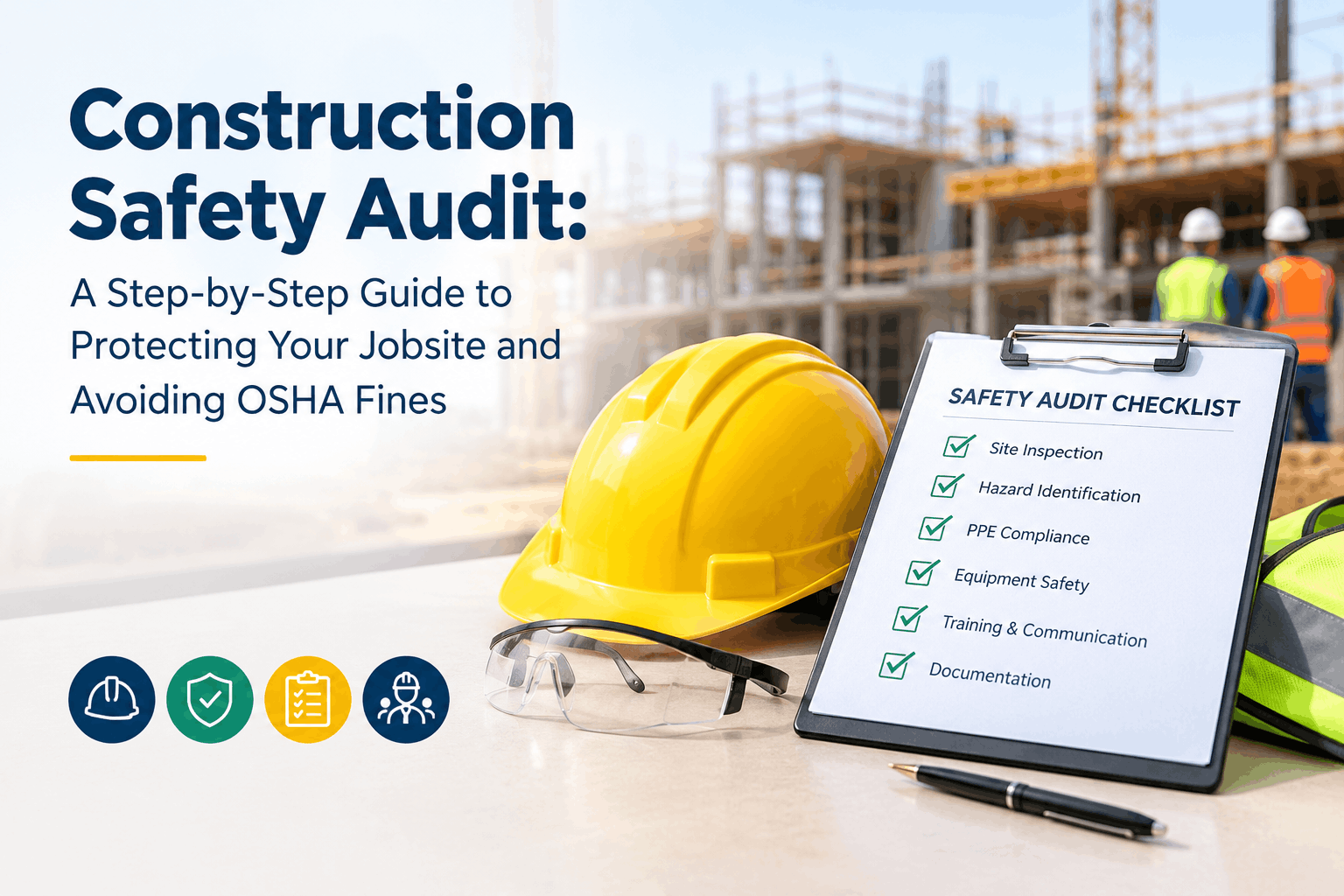
A good construction safety audit checklist covers the essentials without becoming so generic it misses what’s actually unique about your project. The core categories typically include:
- Fall protection:Guardrails, personal fall-arrest systems, openings, ladders, scaffolds, and elevated platforms.
- Electrical safety:Temporary wiring, grounding, GFCI protection, panels, cords, and lockout/tagout procedures.
- Excavation safety:Protective systems, access, spoil placement, inspections, and underground utility identification.
- Equipment safety:Machine guarding, operator qualifications, inspections, maintenance, and safe operating procedures.
- PPE:Availability, condition, correct selection, fit, and worker usage.
- Material handling:Storage, lifting practices, rigging, cranes, forklifts, and load stability.
- Housekeeping:Debris removal, walking surfaces, access routes, waste management, and fire prevention.
- Emergency preparedness:First aid, emergency contacts, evacuation procedures, fire protection, and incident response.
- Training and documentation:Certifications, orientations, permits, incident records, inspections, and corrective actions.
- Subcontractor coordination:Safety responsibilities, communication, shared hazards, and compliance monitoring.
Tailor this list to the project phase, site conditions, workforce, and applicable regulations. A checklist built for a high-rise isn’t going to serve a highway project well, and neither will it work if you just photocopy it from a template and never think about it again.
How Often Should You Audit a Construction Site?
You should not use the audit schedule for every single job. Instead, the audit frequency should match how much risk a project carries. I believe high-risk projects might need audits every month or even more often. On the other hand, lower-risk activities can probably follow a lighter schedule as long as people do regular inspections.
It is also a good idea to run additional audits if something big happens. For example, you should perform audits after a serious incident, a big change in project scope, or when a major subcontractor leaves. You might also need audits when laws change or when a project moves to a new construction phase. Keeping an eye on things helps make sure that safety controls still work well as the site changes.
Choosing a Second-party Construction Safety Audit Partner
Choosing an outside provider takes more than comparing quotes. Look for real construction experience, solid regulatory knowledge, genuine field inspection skills, and a methodology they can walk you through in plain language; not a sales pitch dressed up as a process.
A solid service provider like The Kent Group should come back with clear findings, not some vague observations. It might be worth asking if the reports rank hazards by severity, whether they actually cite the proper standards, and if they spell out workable corrective steps. Also, do they offer follow-up support afterward, or is it just a one-shot document? On top of that, construction site safety audit services really need to stay flexible, because each project type differs, the contractor structure can be quite different too, and scheduling needs shift. In the same line, owner expectations often change the whole approach.
Building a Safety-First Jobsite Culture
Real safety doesn’t come from an occasional paperwork review. It comes from steady observation, genuine accountability, ongoing training, honest documentation, and actually following through on the fixes; week after week, not just when an inspector’s truck pulls up.
A well-run construction safety audit ties all of it together. It shows you what’s working, where the weak spots are, and what needs to change next. Make it a routine part of how projects get run, and the payoff shows up in the places that count: hazards caught earlier, stronger OSHA compliance, fewer disruptions, and crews who make it home at the end of the day. Passing an inspection was never really the goal. The goal is a jobsite where safe practices hold up no matter what changes around them.