
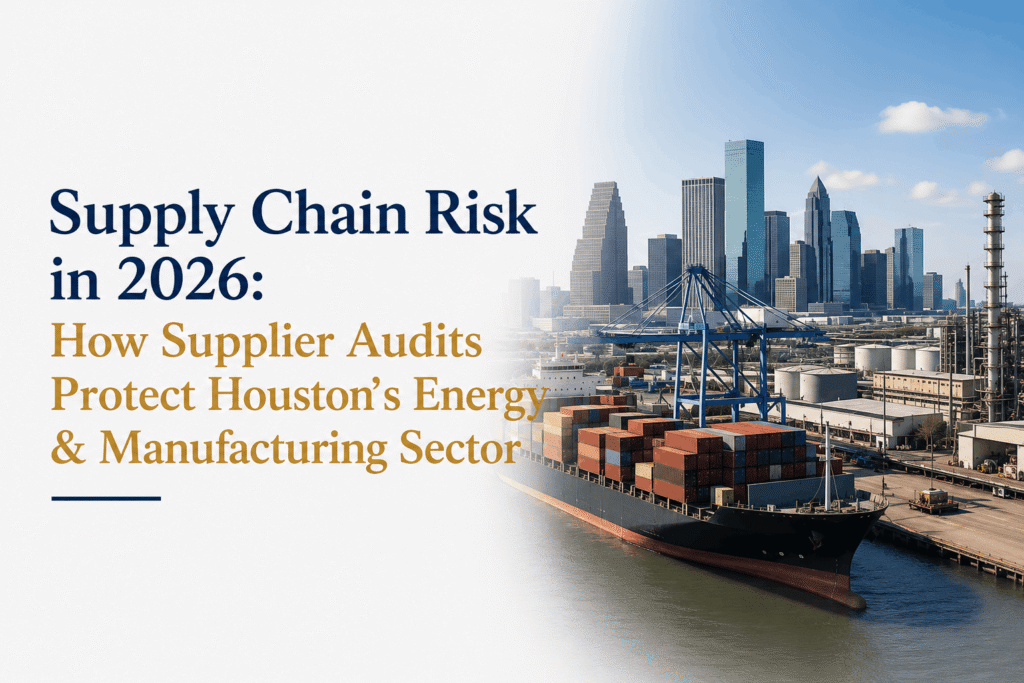
Houston remains one of the most important industrial hubs in the United States. Its economy depends heavily on energy production, manufacturing operations, and international trade. As companies prepare for 2026, supply chain challenges continue to evolve. Global uncertainty, changing regulations, labor shortages, and quality concerns are creating new pressures across industries. These challenges make supplier oversight more important than ever.
Organizations throughout the region are using a supply chain audit in Houston to evaluate supplier performance, verify compliance, and identify operational risks before they create costly disruptions. As supply networks become more complex, audits provide a structured approach to understanding vulnerabilities and maintaining accountability across every stage of the supply chain.
Houston’s supply chain risk profile: Energy sector (petrochemical, LNG, refining), Manufacturing (aerospace, industrial), Port of Houston (logistics)
Houston supports a wide range of industries that rely on strong supplier relationships. The energy sector includes petrochemical plants, LNG facilities, refineries, and oilfield service providers. Manufacturing operations support aerospace, industrial equipment, electronics, and advanced production systems. The Port of Houston continues to serve as a major gateway for domestic and international trade.
These industries depend on suppliers located across the country and around the world. Delays, compliance failures, safety issues, and quality concerns can affect production schedules and operational continuity. As a result, many organizations are strengthening supplier evaluation processes through a supply chain audit in Houston to gain greater visibility into supplier capabilities and performance.
Top Supply Chain Risks in 2026: Geopolitical | Labor | Regulatory | Quality
Many business leaders are asking, “What supply chain risks do Houston companies face?” The answer involves several interconnected challenges that continue to influence operations throughout the region. Geopolitical uncertainty remains a major concern. International conflicts, trade restrictions, and changing tariffs can affect supplier availability and transportation routes. Houston businesses that depend on global sourcing must monitor these developments closely. Labor shortages also continue to impact manufacturing facilities, warehouses, and transportation providers.
Staffing challenges can reduce production capacity and increase delivery delays. Regulatory requirements are becoming more complex. Environmental, workplace safety, and industry-specific regulations require suppliers to maintain strict compliance standards.
Quality issues remain another significant concern. Defective materials, inconsistent production processes, and inadequate quality systems can create disruptions throughout the supply chain. These factors contribute directly to growing Houston supply chain risk across multiple industries.
How Supplier Audits Mitigate Each Risk Type
Supplier audits provide organizations with a clear picture of how suppliers operate. Rather than relying solely on documentation or self-reported information, audits involve direct evaluation of processes, facilities, records, and compliance programs. A qualified second-party auditing company in Houston can assess supplier performance using standardized audit procedures. Auditors review management systems, operational controls, quality practices, workplace safety measures, and regulatory compliance requirements.
When geopolitical risks affect sourcing strategies, supplier audits help organizations verify alternative suppliers before disruptions occur. During periods of labor instability, audits can identify operational weaknesses that may impact production capacity. Regulatory audits confirm whether suppliers follow applicable standards, while quality assessments verify process consistency and product reliability. Through these evaluations, organizations gain objective information that supports informed supply chain decisions.
Industry-specific audit needs:
Energy suppliers: EHS | Construction safety | Process safety
Manufacturing: Quality | EHS | Industrial Hygiene
Food/Hospitality: HACCP | Food safety
The energy industry operates in a highly regulated environment where supplier performance directly affects operational safety and compliance. An energy sector supplier audit in Houston focuses on evaluating suppliers that support refineries, petrochemical facilities, LNG terminals, and related operations. Auditors examine environmental, health, and safety programs along with construction safety procedures and process safety management systems. These reviews help determine whether suppliers follow required standards and maintain appropriate risk controls.
An EHS audit in Houston, Texas, often forms a critical component of supplier evaluations within the energy sector. Auditors review incident management practices, hazard identification programs, employee training records, and compliance documentation. In many cases, organizations also conduct a petroleum supply chain audit in Houston to assess suppliers involved in fuel distribution, storage, transportation, and refining support services.
Manufacturing Audit in Houston, Texas, and Quality Oversight
Manufacturing companies face unique challenges related to product quality, process consistency, and workplace safety. A manufacturing audit in Houston, Texas, evaluates supplier operations to determine whether production systems meet customer and regulatory expectations. Auditors examine quality management systems, production controls, inspection procedures, corrective action processes, and documentation practices.
A quality control audit in Houston, Texas, helps identify potential weaknesses that could affect product quality or delivery performance. Industrial hygiene assessments may also be included when manufacturing environments present occupational exposure risks. These evaluations help organizations understand whether suppliers maintain appropriate workplace controls and employee protection measures.
Food Safety and Compliance Requirements
Food manufacturers, distributors, and hospitality businesses face increasing scrutiny regarding food safety practices. Supplier audits help verify that vendors follow established food safety requirements and maintain proper operational controls. A food safety audit in Houston typically examines sanitation procedures, hazard analysis programs, employee training, traceability systems, and documentation practices. Many organizations also evaluate supplier compliance with HACCP principles to reduce food-related risks within the supply chain. As food safety regulations continue to evolve, supplier audits provide valuable insight into whether vendors maintain consistent compliance and operational discipline.
OSHA Region 6 (Houston/Texas) enforcement focus areas, 2026
Organizations operating in Texas should remain aware of OSHA Region 6 enforcement priorities. Workplace safety remains a significant area of regulatory attention, particularly within industrial and manufacturing environments. An OSHA audit in Houston, TX, often focuses on hazard communication, machine guarding, fall protection, confined space entry, process safety management, and employee training programs. Auditors evaluate whether suppliers maintain appropriate safety controls and documentation that support compliance efforts. Because supplier safety performance can influence overall business risk, many organizations now include OSHA-focused evaluations as part of broader supplier audit programs.
The Kent Group Houston Audit Program
The Kent Group provides comprehensive supplier audit services designed to address evolving supply chain challenges across Houston’s industrial sectors. As a best second-party auditor in Houston, Texas, the company supports organizations through detailed supplier evaluations, compliance assessments, quality reviews, and safety audits.
The audit program addresses energy, manufacturing, petroleum, food safety, environmental health and safety, and regulatory compliance requirements. By applying structured audit methodologies, The Kent Group helps organizations evaluate supplier performance and identify areas requiring corrective action or additional oversight.
Get a Houston Supply Chain Audit
As supply chain risks continue to evolve in 2026, organizations need reliable information about supplier capacity, compliance practices, and operational performance. Independent supplier audits provide valuable insight into risks that may otherwise remain hidden until disruptions occur. If your organization wants to strengthen supplier oversight, reduce uncertainty, and improve supply chain visibility, consider working with experienced auditors who understand Houston’s industrial environment. Contact The Kent Group today to schedule a supply chain audit in Houston and gain a clearer understanding of supplier-related risks across your operations. For more details, you may connect with us at 973-402-5888.
FAQs
What is a supplier audit, and why is it important?
A supplier audit is a structured evaluation of a supplier’s operations, compliance programs, and management systems. The process helps organizations understand how suppliers perform and whether they meet established requirements. Audits provide objective information that supports informed business decisions and supply chain oversight.
How often should companies conduct supplier audits?
The frequency depends on industry requirements, supplier risk levels, and operational complexity. High-risk suppliers may require annual evaluations, while lower-risk vendors may be reviewed less frequently. Organizations often establish audit schedules based on risk assessment findings and compliance obligations.
Which industries in Houston commonly use supplier audits?
Energy, manufacturing, food production, logistics, petrochemical, and industrial service sectors frequently use supplier audits. These industries depend on reliable supplier performance and regulatory compliance. Audits help organizations evaluate operational practices and identify potential concerns before disruptions occur.
What does a second-party auditor evaluate during an audit?
Second-party auditors review management systems, operational controls, safety programs, quality procedures, compliance documentation, and employee training records. The evaluation may also include facility inspections and interviews. Findings are documented to provide an objective assessment of supplier performance.
Can supplier audits help with regulatory compliance?
Yes, supplier audits can identify gaps related to industry regulations and compliance requirements. Auditors assess whether suppliers follow applicable standards and maintain supporting documentation. This process helps organizations better understand supplier compliance status and potential areas requiring attention.