
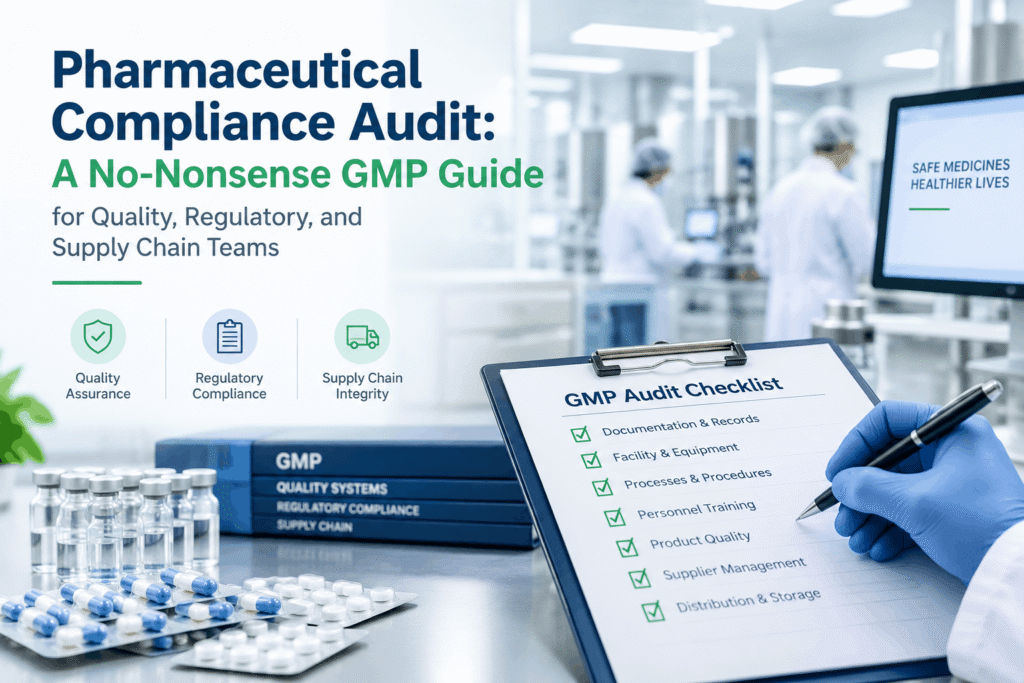
Let’s be honest, making good medicine isn’t just about having a great formula or shiny production equipment. Every single step, from the moment raw materials show up at your dock to the day the finished product leaves for distribution, has to hold up to some pretty serious quality and regulatory scrutiny. That’s where a pharmaceutical compliance audit comes in. It’s how you catch the gaps, size up your suppliers, and keep your Good Manufacturing Practice (GMP) standards intact, ideally before any of it starts affecting product quality or, worse, patient safety.
For quality, regulatory, and supply chain folks, audits are basically your reality check. They give you a real, structured look at how your operational controls, documentation, and risk management are actually holding up, not just how they look on paper. And with regulatory expectations climbing across just about every global market, having a proactive audit strategy isn’t optional anymore. It’s what keeps you inspection-ready, keeps your supply chain moving, and keeps your quality performance solid for the long haul.
So What Exactly Is a Pharmaceutical Compliance Audit?
Think of it as a full check-up for your company, facilities, processes, documentation, quality systems, all of it, measured against the regulations you’re supposed to be following and your own internal standards. The whole point is to figure out whether what’s happening on the ground actually lines up with current Good Manufacturing Practice (cGMP), your quality agreements, and your own written procedures.
Sometimes these audits are done in-house. Sometimes you bring in independent consultants or third-party firms. How deep the audit goes depends on the facility, how risky the product is, what regulations you’re on the hook for, and why you’re doing the audit in the first place. And here’s the thing; a good audit doesn’t just point out what’s wrong. It helps your team understand why things went sideways and build corrective actions that actually stop the problem from happening again, instead of just patching it up temporarily.
cGMP, GxP, and Where the FDA Fits In
Current Good Manufacturing Practice (cGMP) lays out the baseline rules for manufacturing, processing, packaging, and storing pharmaceutical products. GxP is the bigger umbrella term; it covers GMP along with other regulated practices like Good Laboratory Practice (GLP) and Good Clinical Practice (GCP).
Here in the U.S., the FDA is the one enforcing drug manufacturing rules through regulations, inspections, and ongoing compliance checks. That means your company needs documented processes, facilities that are actually fit for purpose, properly trained people, and quality systems you can trust, all in service of making sure the product is safe, correctly identified, and consistently strong, pure, and high quality.
Why Pharmaceutical Compliance Audits Actually Matter in 2026
Regulations Are Only Getting More Complicated
Most pharma companies these days aren’t just selling in one country; they’re juggling multiple markets, and every single one has its own regulatory quirks and inspection style. If you’re shipping product into the U.S., the EU, and anywhere else, you’ve got to somehow keep your corporate quality systems aligned with a patchwork of regional rules.
A solid pharmaceutical compliance audit helps you spot where your corporate procedures, your suppliers’ practices, and regional requirements aren’t quite matching up. Taking a risk-based approach to auditing also means you can put your energy where it counts most; critical manufacturing steps, data integrity, contamination risks, and anything that could actually hurt product quality.
Nobody Wants a Recall, Warning Letter, or Import Alert
Weak quality controls have a way of snowballing, manufacturing deviations turn into recalls, recalls turn into regulatory observations, and before you know it, your supply chain is in chaos. An audit can’t promise you’ll never get dinged by regulators, but it sure can help you spot trouble while it’s still small.
A structured approach to FDA GMP audit prep means actually digging into your documentation, looking hard at deviations that keep popping up, and making sure your corrective actions are doing what they’re supposed to. Catch it early, and you save yourself a world of operational headaches, plus you walk into any regulatory inspection a lot more confident.
At the End of the Day, It’s About Patients (and Trust)
Quality failures in pharma aren’t just a paperwork problem; they can hit patients directly, disrupt treatment, and chip away at trust in your brand. Audits give you a real shot at checking whether your processes are actually protecting product quality all the way through the supply chain, not just on the days someone’s watching.
A strong audit program also builds accountability into the culture. When your team is writing down findings, assigning ownership, and actually tracking corrective actions over time, quality stops being something you scramble for right before an inspection; it becomes part of how you operate every day.
The Different Flavors of Pharmaceutical Compliance Audits
Internal Quality System Audits
These look inward, checking whether your own quality management system is actually running the way your approved procedures and the regulations say it should. Quality teams dig into deviations, change controls, how effective your training really is, validation records, and how complaints get handled.
Internal audits are your early-warning system before an external inspection walks through the door. A well-run pharmaceutical quality management audit can also tell you whether your quality unit’s responsibilities are clearly spelled out, and whether your corrective actions are actually fixing root causes instead of just slapping a band-aid on the symptom.
Third-Party Supplier and Vendor Audits
These are all about sizing up the companies feeding into your supply chain, the ones providing your active pharmaceutical ingredients (APIs), excipients, packaging, lab services, or contract manufacturing.
A pharmaceutical supplier audit usually digs into manufacturing controls, material testing, traceability, data integrity, and whether the supplier is actually holding up their end of the quality agreement. How deep you go should track with how much that supplier’s work could impact your product quality and patient safety.
Pre-Approval and Regulatory Inspection Readiness Audits
These help you figure out, honestly, whether your facilities and quality systems are actually ready for a regulator to walk in the door. Teams comb through application-related processes, validation paperwork, batch records, and how prepared they are to respond during an inspection.
These are especially worth doing when you’re launching a new product, ramping up manufacturing capacity, or you’ve got a regulatory inspection on the horizon.
What Actually Gets Looked At During a Pharmaceutical Compliance Audit
Facilities, Equipment, and Material Controls
Auditors want to know: are your facilities, utilities, equipment, and production areas genuinely fit for what you’re using them for? That means digging into environmental controls, cleaning procedures, equipment maintenance, calibration, and how you’re preventing contamination.
Material controls matter just as much. Auditors will check whether incoming ingredients are properly identified, tested, stored, and released for use. FDA warning letters have called out companies more than once for gaps in supplier qualification and weak incoming material testing, which tells you exactly why these controls need to be documented, not just assumed.
Documentation, Data Integrity, and Batch Records
Pharma manufacturing lives and dies by accurate, complete, traceable records. Auditors will typically go through your SOPs, batch manufacturing records, lab results, deviation reports, and training documentation with a fine-tooth comb.
Data integrity checks look at whether your records are attributable, legible, made in real time, original, and accurate, the classic “ALCOA” principles. Electronic systems need proper access controls, audit trails, and a real process for managing any changes to data. If your records are missing or shaky, you’re going to struggle to prove your processes are consistently hitting spec.
Supplier Qualification and Risk Classification
Supplier qualification is basically how you figure out whether a vendor can reliably deliver materials or services that meet your requirements. That process might involve questionnaires, document reviews, quality agreements, ongoing performance monitoring, and actual on-site visits.
A risk classification system helps you sort suppliers by how critical their material is, how complex their manufacturing is, their track record, and how regulatory-significant they are. Your high-risk suppliers need a lot more attention than, say, whoever’s supplying your shipping boxes.
Walking Through the Pharmaceutical Compliance Audit Process
Planning and Risk-Based Scoping
Every good audit starts with clear objectives, scope, and criteria. That means figuring out upfront which facility, which processes, which products, which suppliers, and which regulatory standards you’re actually reviewing.
A cGMP audit checklist is a great way to organize your criteria across quality systems, facilities, production, lab controls, and material management. But it should be a tool to support your team’s judgment, not a substitute for actually thinking through the risks.
Planning also means nailing down the schedule, figuring out what documents you’ll need, who’s responsible for what, and how you’re going to classify findings once you have them. Keeping all this organized upfront keeps the whole review focused on what actually matters.
On-Site or Remote Facility Assessment
Depending on what you’re trying to accomplish and how risky the area is, audits can happen on-site, remotely, or as a hybrid of both. On-site visits let auditors actually watch how manufacturing runs, check out facility conditions, see how materials are handled, and observe employees doing their jobs.
Remote audits are great for document reviews, interviews, and certain quality system checks. But let’s be real, some things just need eyes on the ground. You can’t fully replace physical observation with a video call.
Whatever the format, auditors need to document real evidence, record what they actually see accurately, and be clear about what’s a confirmed problem versus what just needs more digging.
Deviation Reports and CAPA Tracking
Findings need to be written up clearly, what was observed, what requirement it violates, what the potential impact is, and what evidence backs it up. Bigger findings usually need a proper root-cause investigation.
Corrective and preventive action (CAPA) plans should spell out who’s responsible, when it needs to be done, and how you’ll check that it actually worked. Just rewriting an SOP or sending people back through training won’t cut it if the real problem is a deeper process weakness. FDA guidance is pretty clear that adequate responses and real corrective action after inspection observations are a big deal, not just a box to check.
Getting Your Supply Chain Ready for a Pharmaceutical Compliance Audit
Supply chain readiness starts with keeping your supplier records current and your qualification decisions actually documented. Quality and procurement need to work together to keep approved supplier lists, quality agreements, risk assessments, and performance reviews accurate and up to date.
Here’s a practical way to get ready:
Review your supplier qualification files, Make sure your critical suppliers actually have documented approval, quality assessments, and current supporting info on file.
Refresh your cGMP audit checklist, Add in supplier controls, material testing, traceability, and whatever regulatory requirements apply to you.
Take a real look at quality performance, Track rejected materials, deviations, complaints, late deliveries, and anything that keeps happening again and again.
Double-check your documentation, Certificates of analysis, specs, audit reports, quality agreements, make sure they’re accessible and not outdated.
Test whether your CAPAs actually worked, Go back and confirm that past audit findings were actually resolved, and that the fixes made a real, measurable difference.
It’s also worth building clear escalation procedures for when a supplier’s performance really goes off the rails. If there’s a real product quality risk, you might need extra testing, temporary restrictions, requalification, or, worst case, cutting the supplier loose.
Picking the Right Independent Pharmaceutical Compliance Audit Partner
Choosing an outside audit partner takes more than just checking their consulting resume. You want to know they’ve got real technical know-how, relevant industry experience, a solid grip on the regulations, and the ability to actually evaluate complicated quality systems.
The Kent Group is one option worth looking at for structured compliance and quality assessment support. Whoever you pick, make sure they’ve got real experience with the GMP requirements that apply to you, supplier assessments, documentation reviews, and evaluating CAPAs.
A good partner should hand you objective findings, practical recommendations, and evidence that’s actually documented well. Independence matters here; it means the reporting stays honest and you’re less likely to have deficiencies swept under the rug because of internal pressure.
FAQs
What’s the difference between a GMP audit and an FDA inspection?
A GMP audit is usually something you do internally or bring in a third party for; it’s about checking compliance and finding room to improve. An FDA inspection, on the other hand, is done by the regulator itself, and it can lead to a Form FDA 483 with observations, a compliance review, or regulatory action if they find real problems. Worth noting: a Form FDA 483 is just a record of observations, it’s not a final decision from the agency.
How often should pharmaceutical suppliers get audited?
It really should be risk-based. Your critical API suppliers and anyone whose materials heavily impact product quality probably need more frequent check-ins, while lower-risk vendors can be looked at less often. Annual audits, or maybe every two to three years, are common starting points, but the real answer depends on documented risk, supplier track record, and your own internal procedures.
What documentation gets pulled during a pharmaceutical compliance audit?
Usually batch records, SOPs, change control docs, deviation logs, training records, equipment qualification and calibration records, supplier qualification files, and data integrity controls. Exactly what gets reviewed depends on the audit’s scope, what the facility does, the type of product, and which regulations apply.
What happens if a supplier fails a pharmaceutical compliance audit?
You’ll typically end up with documented findings that need to be investigated and corrected. The supplier might have to submit a CAPA plan with clear ownership and deadlines. Depending on how bad, or how persistent, the issues are, you might need follow-up audits, tighter controls, a suspension, or in serious cases, cutting the supplier off entirely.
Do third-party audits satisfy FDA supplier qualification requirements?
They can help; a solid third-party audit can support your supplier qualification and oversight program if it’s reliable, relevant, and well documented. But at the end of the day, it’s still on you as the manufacturer to evaluate your suppliers and keep up your own oversight. A third-party report alone doesn’t automatically check every regulatory box for you.
What does a risk-based approach to pharmaceutical supplier audits actually look like?
It’s about prioritizing audits based on how much a supplier could actually affect product quality and patient safety. Your API and critical excipient suppliers usually need a much closer look than, say, a low-risk packaging or logistics vendor. Frequency, scope, and any follow-up should all trace back to documented risk assessments.
Wrapping It Up: Building a Supply Chain That’s Always Audit-Ready
A pharmaceutical compliance audit isn’t a box you check once a year and forget about; it’s a core piece of your quality assurance, regulatory readiness, and supply chain risk management. By taking a real look at your facilities, documentation, suppliers, and corrective actions, you can catch weak spots before they turn into much bigger problems.
The best audit programs combine risk-based planning, solid documentation, qualified auditors, and CAPA tracking that doesn’t just stop after the report gets filed. Quality, regulatory, and supply chain teams should treat being audit-ready as just… part of the job, not something you scramble to pull together right before an inspection shows up.
With the right structure in place and the right independent support behind you with the Kent Group, pharma companies can build stronger supplier accountability, sharpen their quality systems, and stay solidly aligned with whatever GMP expectations come their wa